In Stock
Share your international phone number to discuss pricing and delivery:
Buy this product in 1 click:
Or contact us directly via:


Share your international phone number to discuss pricing and delivery:
Or contact us directly via:
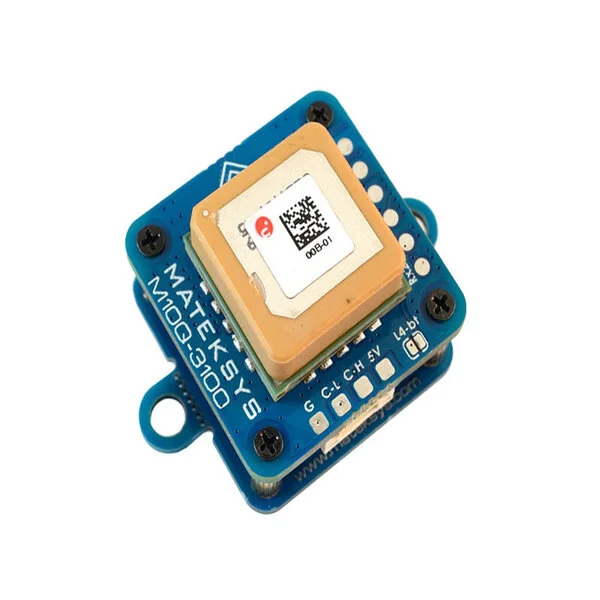
The Matek M10Q-3100 is a high-performance GNSS + Compass module integrating a u-blox M10 series multi-constellation GNSS receiver and a PNI RM3100 industrial-grade magnetometer. It provides precise position and heading data for drones, robotics, and other navigation systems. The module supports CAN (DroneCAN) and UART/MSP interfaces, features a compact design, and ensures strong anti-jamming performance with its 15 × 15 mm high-gain patch antenna.
Table 2-1. M10Q-3100 GNSS + Compass Specifications
| Manufacturer | Matek Systems |
| Model | M10Q-3100 |
| GNSS Chipset | u-blox M10 (GPS, GLONASS, Galileo, BeiDou) |
| Compass Sensor | PNI RM3100 magnetometer |
| Interface | CAN (C-H, C-L, DroneCAN protocol), UART/MSP |
| Supply Voltage | 4.5 V – 5.3 V (nominal 5 V) |
| Current Consumption | ≈ 50 mA (typical) |
| Patch Antenna | 15 × 15 mm ceramic high-gain antenna |
| Dimensions | 36 × 15 × 16 mm |
| Weight | ~12 g |
| Operating Temperature | -20 °C ~ +85 °C |
| Firmware Support | ArduPilot AP_Periph / PX4 CAN peripheral |
Table 3-1. Power and Signal Parameters
| Parameter | Min | Typ | Max | Unit |
|---|---|---|---|---|
| Supply voltage (VCC) | 4.5 | 5.0 | 5.3 | V |
| Operating current | - | 50 | 60 | mA |
| CAN interface voltage | - | 5.0 | - | V |
| UART interface voltage | 3.3 | 3.3 | 5.0 | V |
Table 4-1. Module Dimensions
| Dimensions (L × W × H) | 36 × 15 × 16 mm |
| Weight | 12 g |
| Mounting Type | Four mounting holes (M2.5) |
| Antenna | Integrated ceramic patch antenna |
NOTE: For optimal GNSS performance, mount the module with clear sky view and avoid interference from high-current circuits.
Table 5-1. GNSS and Compass Performance
| GNSS Constellations | GPS L1, GLONASS L1, Galileo E1, BeiDou B1C |
| Position Accuracy | 2.0 m CEP (open sky) |
| Cold Start | < 26 s |
| Hot Start | < 1 s |
| Reacquisition | < 1 s |
| Compass Resolution | < 0.5° typical (after calibration) |
| Heading Accuracy | ±2° (typical, after field calibration) |
Table 7-1. Environmental Specifications
| Operating Temperature | -20 °C ~ +85 °C |
| Storage Temperature | -40 °C ~ +90 °C |
| Vibration Resistance | IEC 60068-2-6 compliant |
| Humidity | 5 % ~ 95 %, non-condensing |
There are no reviews for this product.
There are no reviews for this product, be the first to leave your review.